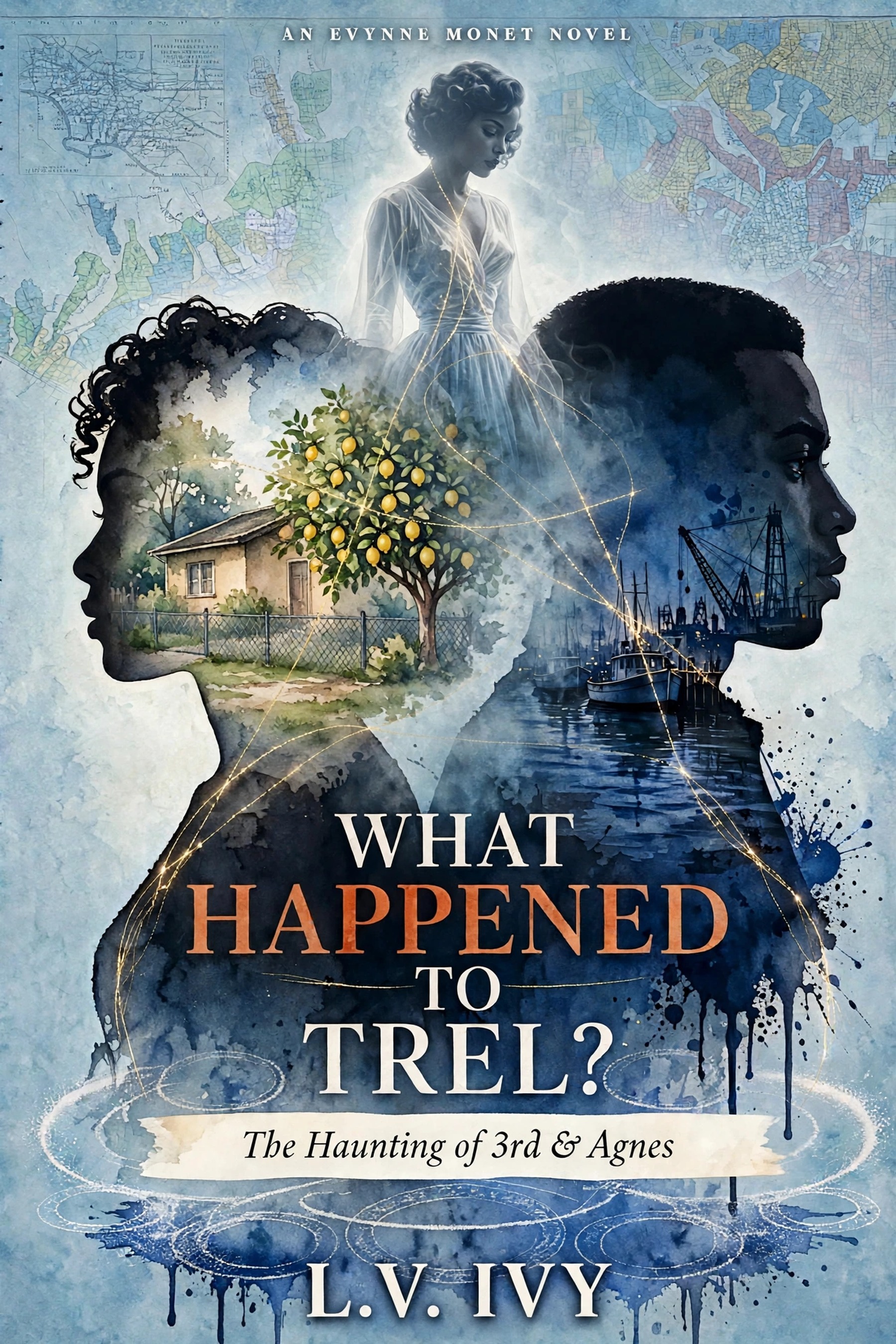
BOOK ONE · LYNWOOD, 1985
3RD & AGNES
Fifteen, exiled from the Westside to a tan stucco house on a corner in Lynwood, Evynne learns what a block can take from you, and what it gives you anyway.
Available now · eBook & Paperback
Start with Book OneSTART HERE
You don't need Book One. This story stands on its own. Evynne Monet is a detective now, with gray in her hair and a thirteen-year-old daughter who notices too much. She stopped saying Trel's name a long time ago. Then a man in a church suit is found laid out in a ring of salt behind a construction fence, with a card in his pocket: FIND TREL. Everybody she asks has a different version of what happened to the boy from the corner. Somebody wants him found. Or somebody wants her looking.
You remember the envelope. The loopy handwriting, like a chain of flowers. The question 3rd & Agnes would not answer. Years later another envelope came. Same hand. Different sentence. This is what that sentence started: Evynne, grown and wearing a badge, finally going looking for the boy nobody else bothered to find. Every name you knew is still here. So is the corner.
Some doors you don't open until you have to.
CASE FILE · SOUTH LOS ANGELES
Seven things from the first chapters. Tap one to pull it out of the box.
{{ cur.body }}
{{ cur.quote }}
YOUR THEORY
{{ theoryReply }}
That's one version. Evynne hears five. Only one of them is true, and it costs her something to find it.
Find out in the book ↑READ THE OPENING
Every summer of my childhood I flew to Houston by myself with a plastic wing pinned to my shirt, and every Sunday of every one of those summers, my grandfather read from the family Bible. As far as I know, he never once read the Bible.
That was the joke in his house, though nobody said it loud enough for him to hear. Pépère kept the Bible on top of the china cabinet in his place off Cullen, out where Houston quits pretending to be a city and lets itself go back to country. After Sunday supper, when Miss Odette had cleared the plates and the grown folks had carried their coffee out to the porch to catch whatever breeze the evening was willing to give, he would reach up and take it down. Black leather gone brown at the corners. Heavy as a cinder block. And wound twice around it, like the beads were the only thing keeping it shut, was a rosary.
The rosary had been mine.
Pépère unwound the beads slowly, laid them across his knee, and opened the Bible to the same place he opened it every time. Not Genesis. Not the Psalms. A sheet of paper folded in quarters, gone soft as cloth from being opened and closed for longer than anybody on that porch had been alive.
He cleared his throat, and the evening changed.
Then he turned the paper over. The back was crowded with writing. Pencil, mostly, in three or four different hands. Some of it was so faded it looked like a watermark.
Two hearts on the water, two boats on the sea,
One sailed for the bayou, and one sailed from me.
The soldiers kept count, but they didn't count right.
They wrote down the cargo and left out the light.
So children of children, keep walking, keep on.
Keep asking the river where all of us gone.
And when the last mile runs out under your feet,
Look up. That's the corner. That's where we meet.
“We'll find each other where the road ends.”
“Where does the road end, Pépère?”
He looked at me for a long time, like he was deciding how much I could carry. “Depends on who's walking it, cher,” he said.
That was when I saw her. Past the yard, past the fence, out where Cullen ran off into the dark, there was one streetlight that had just come on. And under it, a woman was standing at the edge of the road. She wore a white dress, old-fashioned, the kind you only saw in pictures. She was looking at the house.
When everybody turned to look, the road was empty.
But Pépère didn't laugh. He folded the paper into quarters, laid it back inside the Bible, and wound the rosary around it twice, tight, the way you'd tie up something that might get loose.
“She heard you,” he said.
He wasn't talking to me.
· · ·
I'm a detective now. You'd think I would remember a thing like that. I didn't. I forgot that Sunday for most of my life.
Then a dead man turned up behind a construction fence in South Los Angeles with a note in his pocket that said FIND TREL, and the first thing I thought of wasn't Trel.
It was a woman in white under a streetlight on Cullen.
CULLEN STREET · AFTER DARK
{{ slText }}
Every time you look away, she's somewhere else.
SOUL TIES
In this family, love isn't a feeling. It's a thread. Tap a name and pull.
{{ curTie.name }}
{{ curTie.body }}
EXHIBIT A
{{ circleText }}
“You smell like dirt. And something else. Sad dirt. Like a cemetery.”
MIA, THIRTEEN, AT BREAKFAST
WALK THE CASE
The people are invented, and so is the case. The map isn't. If you grew up in this city, you might find your street in here.
{{ curPlace.kicker }}
{{ curPlace.body }}
{{ curPlace.ch }}
THE TRACKLIST
Flip the tape.
This is a horror story. It's meant to scare you. Open the list if you'd like to know what's inside first.
THE EVYNNE MONET NOVELS
BOOK ONE · LYNWOOD, 1985
Fifteen, exiled from the Westside to a tan stucco house on a corner in Lynwood, Evynne learns what a block can take from you, and what it gives you anyway.
Available now · eBook & Paperback
Start with Book OneBOOK TWO · SOUTH L.A., NOW
Forty years later, a body, a ring of salt and a name she hasn't said out loud since she was fifteen. You're on this book's page.
Kindle eBook · 6 × 9 Paperback
Get the book ↑BOOK THREE
She grew up, put on a badge, and went looking. She isn't done. Neither is whatever was watching from under the streetlight.
Hear about it first ↓THE PRESS SPEAKS
News from Lived It Press: what's next for Evynne, new books from L.V. Ivy, and the real L.A. history behind the stories. No noise.
A review wherever you read it helps more than almost anything else. It's how an independent book finds its next reader.
She heard you.
You've been on this page a while.